
From Bias to Access: Redesigning Ai for equitable patient care
August 2026
INTRODUCTION
Artificial intelligence (“AI”) holds an incredible promise to transform healthcare, from accelerating research and diagnosis to optimizing workflows to empowering people. However, when AI systems are used to determine clinical outcomes without expert human oversight, a serious risk exists for those systems to exponentially increase bias and health inequities instead. In this report, we show that AI can meet its incredible promise for better, equitable healthcare – when designed and implemented correctly. We explore this journey through two critical lenses: first, correcting clinical algorithms to be equitable and fair, and second, launching new AI tools that directly connect with underserved communities and expand patient access to health information and support.
CASE 1: ALGORITHM REFINEMENT IN KIDNEY DISEASE
Chronic kidney disease (CKD) is a major public health challenge affecting an estimated 37 million U.S. adults, defined by kidney damage (often marked by excess albumin in the urine) or loss of the kidneys' ability to filter natural wastes from the blood [1].
To test kidney function, doctors use the estimated Glomerular Filtration Rate (eGFR), a foundational clinical score built directly into Electronic Health Record (EHR) systems that is the primary test of kidney function.
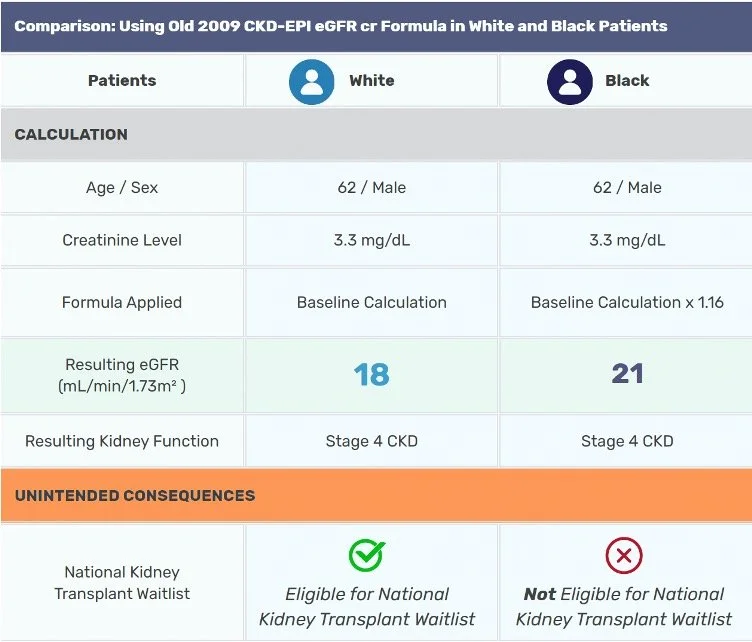
Until 2021, metrics relying on a race-dependent equation had been widely used, systematically presenting a distorted view of actual kidney health, masking the very disparities it was meant to detect. By artificially inflating kidney function scores for Black patients, the algorithm created inequities, most notably delaying patient eligibility on life-saving National Deceased Donor Kidney Transplant Waitlists [See Tables 1 and 2].
Table 1: Organ Procurement and Transplant Network (OPTN) Kidney Waitlist
Eligibility Requirements [2].
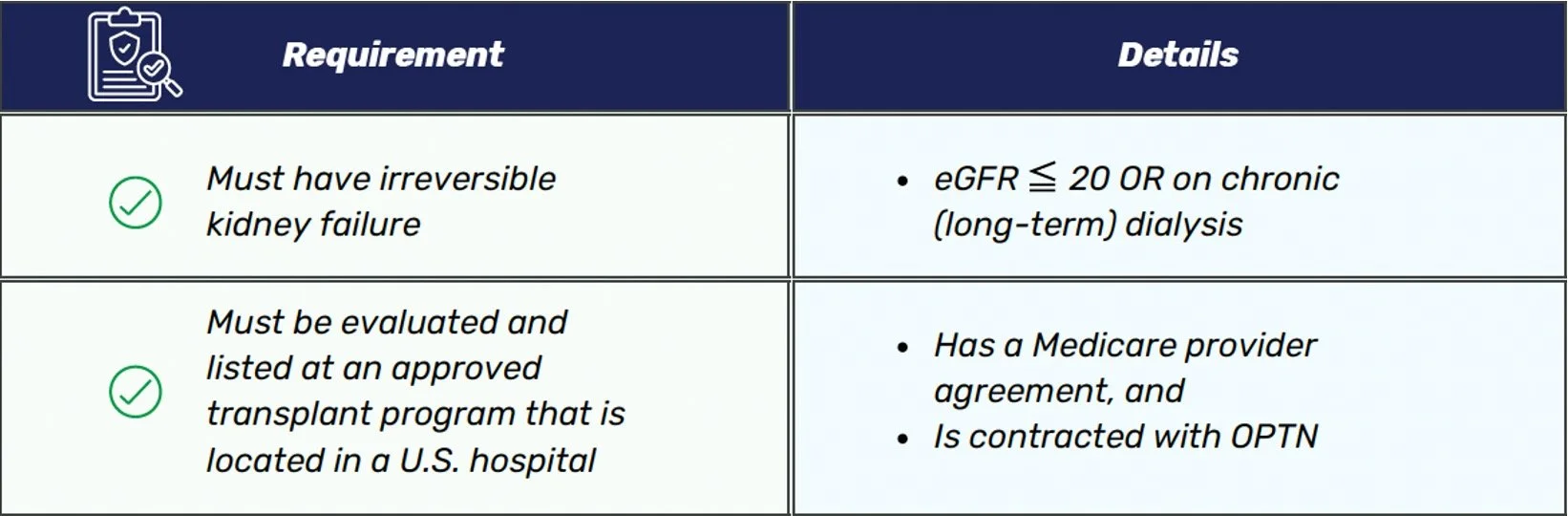
Table 2: An example of how 2009 CKD-EPI eGFR, a race-dependent equation, presented
a different view of kidney health for Black and non-Black patients [2].
Inspired by pressure from healthcare professionals, medical students, and patient advocacy groups to fix these erroneous algorithms, Dr. Joseph Vassalotti, Clinical Professor of Medicine at the Icahn School of Medicine at Mount Sinai and Chief Medical Officer at National Kidney Foundation (NKF), championed a new, universal race-free equation to calculate eGFR and patient eligibility for kidney transplants.
“Equity is fundamental to kidney health and care. When we use race in eGFR calculations, we risk treating the social construct of race as though it were a biological one, reinforcing the misconception that disparities in kidney health are immutable facts rather than inequities that require intervention. Refining the eGFR equation for all individuals was an important step toward advancing kidney health equity and achieving standardized laboratory reporting.”
Dr. Joseph Vassalotti, Chief Medical Officer, National Kidney Foundation
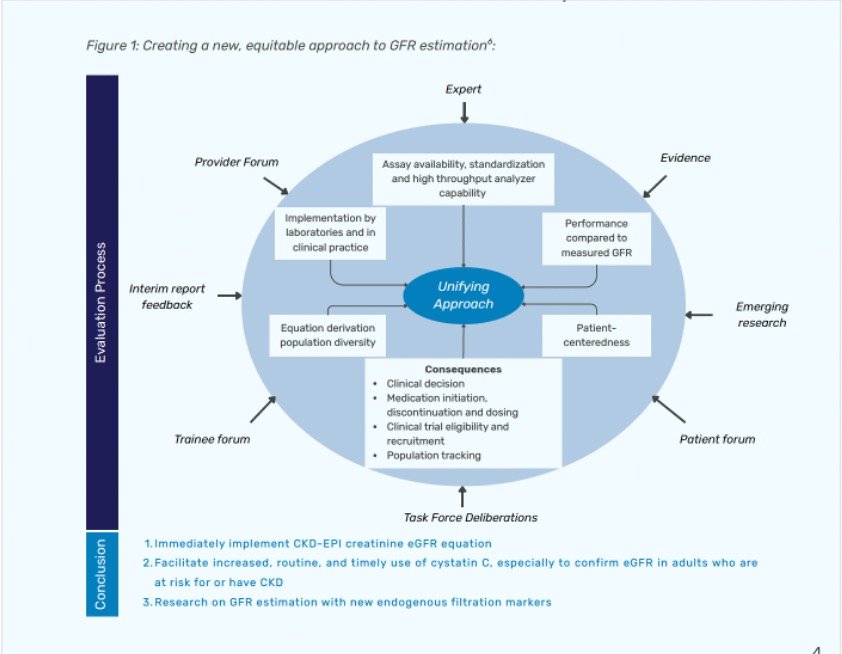
Beginning in 2020, NKF and the American Society of Nephrology (ASN) drove a wave of systemic innovation by establishing a joint task force, comprising a diverse group of nephrologists, a clinical laboratory professional, a pharmacist, a public health professional, and most importantly, patient advocates [3-5]. This task force dedicated 10 months to rigorously evaluating 26 different mathematical approaches to deliver an equitable eGFR calculation [See Figure 1] [6]. Subsequently, the Organ Procurement and Transplantation Network (OPTN) mandated U.S. kidney transplant programs to submit wait time modifications for Black patients who were disadvantaged by the equation and had endured prolonged waiting for life-saving kidney transplants [7].
“The task force aimed to come to a solution that was actually data-driven and evidence-based.”
Dr. Joseph Vassalotti, Chief Medical Officer, National Kidney Foundation
Figure 1: Creating a new, equitable approach to GFR estimation [6].
Ultimately, this update to the eGFR calculation successfully closed a critical gap in equitable care, proving that when clinical algorithms are actively audited and redesigned, they can become powerful instruments for fair, optimal patient outcomes.
The collaboration between NKF and ASN shows us how patient advocacy and systemic auditing can dismantle embedded health disparities. While NKF continues to champion the race-free eGFR equation as a universal tool for algorithmic equity and many national labs apply the new equation, implementation remains uneven as many underserved communities and local clinics lack the financial and operational resources required to upgrade their EHR diagnostic software systems. Despite these ongoing infrastructure gaps, the transition to the new race-free equation has successfully forced a critical conversation across healthcare, driving the industry closer to eliminating systemic disparities at the root, beginning in kidney health.
CASE 2: AI EXECUTION IN PROSTATE CANCER
This case represents the next phase of the evolution for equitable AI: proactively designing and executing AI programs that remove systemic barriers and advance patient access and equity.
ZERO Prostate Cancer (ZERO), the leading national patient advocacy organization for people impacted by prostate cancer, developed ZERO's Access to Community Health (ZACH), an AI-powered support companion that operates as a 24/7, text-based SMS system and provides immediate, accurate, and credible responses, with the goal of reaching at-risk patient communities facing the steepest hurdles in prostate healthcare, including Black men, Veterans, and rural underserved populations [8-10]. The tool, by design, is user-friendly and widely accessible; the SMS technology does not require a smartphone.
“ZACH represents a breakthrough in how we serve the prostate cancer community by meeting people where they are. We’re removing barriers to support and ensuring that no one faces this disease alone.”
Courtney Bugler, President and CEO, ZERO Prostate Cancer
The development of ZACH was a collaborative effort, built with input from medical experts, ZERO's network of support group leaders, and its patient and caregiver advisory board. From its inception, its mission was universal accessibility and reaching all patient communities, including the highest-risk groups. To ensure the platform served its audience, the team launched a series of coordinated, phased rollouts designed specifically to gather feedback from patients, caregivers, and advocates.
Admittedly, ZACH is a newly launched platform, undergoing continuous refinement to optimize its performance and capabilities. It is the reality that aligns with the broader public awakening to the imperfections of artificial intelligence. However, Courtney views these early limitations not as failures, but as invaluable learning opportunities to refine prompts and improve accuracy.
“If you wait until every answer AI gives is perfect, the tool will never launch…
If we don’t deploy these responsible tools now, we leave a void, putting people’s data and privacy at greater risk on unverified platforms.”
Courtney Bugler, President and CEO, ZERO Prostate Cancer
ZACH is a continuously evolving system. Much like the early internet, it requires constant updates to sharpen its accuracy and relevance. “Within our first week of going public, we discovered areas for improvement and immediately made adjustments,” says Bugler. “Now, we push updates and edits every few weeks.” To maintain high-quality data relevance and user privacy, the system operates on a closed-loop framework backed by active human oversight, ensuring the information remains securely tailored to the specific needs of its users.
Today, ZACH is helping ZERO Prostate Cancer not only shape real-time resource delivery but also analyze meaningful Key Performance Indicators such as user satisfaction sentiments and recurring search trends, which help ZERO to pinpoint exactly where information gaps exist and quickly design programs to fill them.
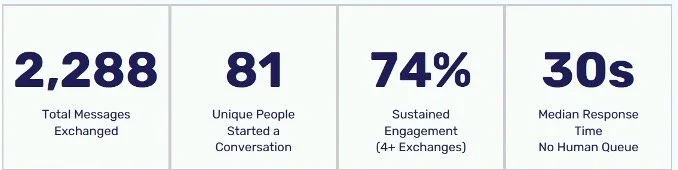
Figure 3: Real-time user sentiments [11]:
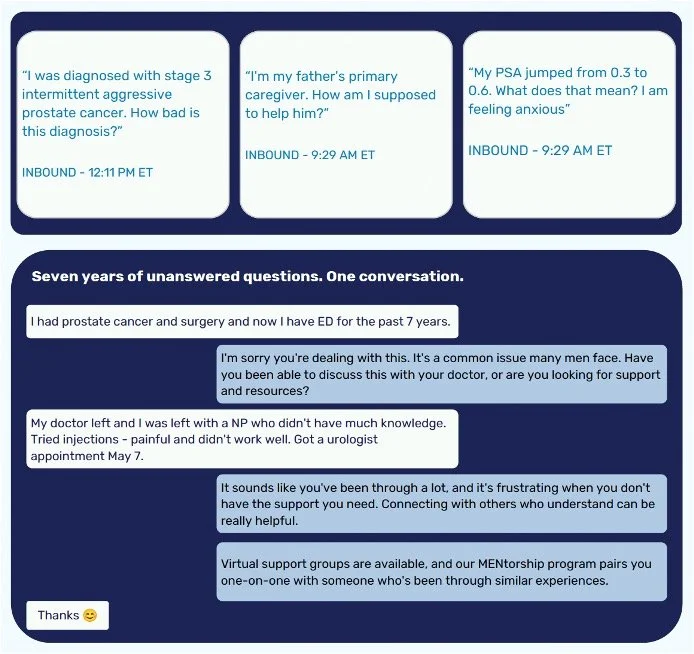
Launched in April 2026, ZACH instantly demonstrated its vital necessity. By pairing real-time data with community feedback, ZACH demonstrates how artificial intelligence can successfully bridge geographic and socioeconomic divides, delivering essential medical education directly to the patients and communities that need it most.
The tool's long-term viability is secured through its closed-loop data privacy framework and a commitment to rapid, iterative updates, proving that maintaining a trusted AI asset requires active, ongoing human governance rather than a 'one-and-done' launch based only on technology and algorithm development.
CONCLUSION
Together, these initiatives led by NKF with ASN and ZERO illustrate that the true power of healthcare AI lies not just in its computational capacity, but in its intentional design and oversight. Whether by auditing flawed clinical algorithms to eliminate racial biases in kidney care or by deploying accessible, text-based AI companions to support underserved prostate cancer patients, these cases prove that technology can be a profound force for equity.
Achieving this promise of AI for better healthcare requires moving away from passive adoption and toward active, human-centered governance. By combining rigorous scientific data, real-time feedback, and diverse community collaborations, the healthcare ecosystem can successfully transform AI into a safe, trusted, and impactful partner in patient care.
CITATIONS
Chronic Kidney Disease in the United States, CDC, 2023. https://www.cdc.gov/kidney-disease/media/pdfs/CKD-Factsheet-H.pdf
Your Guide to Kidney Transplant, American Kidney Fund, 2026. https://www.kidneyfund.org/sites/default/files/media/documents/guide-to-kidney-transplant-05-19-2026.pdf
Interview with The National Kidney Foundation (NKF)
Establishing a Task Force to Reassess the Inclusion of Race in Diagnosing Kidney Diseases. National Kidney Foundation. Published July 2, 2020. https://www.kidney.org/press-room/establishing-task-force-to-reassess-inclusion-race-diagnosing-kidney-diseases
Changes to eGFR Calculation and What that Means for People Living with Kidney Disease. National Kidney Foundation. Published September 23, 2021. https://www.kidney.org/news-stories/changes-to-egfr-calculation-and-what-means-people-living-kidney-disease
Delgado C, Baweja M, Crews DC, et al. A Unifying Approach for GFR Estimation: Recommendations of the NKF-ASN Task Force on Reassessing the Inclusion of Race in Diagnosing Kidney Disease. Journal of the American Society of Nephrology. 2021;32(12):2994-3015. doi:https://doi.org/10.1681/asn.2021070988
Khazanchi R, Fleishman A, Eneanya ND, Michelson KA, Diao JA, Morse M, Pavlakis M. Wait Time Modifications for Black Transplant Candidates Affected by Race-Based Kidney Function Estimation. JAMA Intern Med. 2026 May 1;186(5):517-530. doi: 10.1001/jamainternmed.2026.0001. PMID: 41801177; PMCID: PMC12973219.
Meet ZACH. Zero Prostate Cancer. https://zerocancer.org/zach
ZERO Introduces ZACH, The First Ever SMS-Based AI Support Platform for Prostate Cancer. Zero Prostate Cancer. https://zerocancer.org/stay-informed/press-releases/zero-introduces-zach-first-ever-sms-ai-support-for-prostate-cancer
Interview with Zero Prostate Cancer
Troop F. Day One: ZERO Prostate Cancer × ZACH Launch Day Report. Zero Prostate Cancer. Published April 30, 2026. Accessed July 2, 2026. https://zero-zach-launch.netlify.app/
CONTRIBUTORS

ACKNOWLEDGEMENTS
DKI Health would like to thank the National Kidney Foundation and ZERO Prostate Cancer for sharing their insights and input into this paper:
Dr. Joseph A. Vassalotti, Chief Medical Officer, National Kidney Foundation and Professor of Medicine, Icahn School of Medicine, Mount Sinai
Courtney Bugler, CEO and President, Zero Prostate Cancer and Member, DKI Health Patient & Caregiver Advisory Council
ABOUT DKI HEALTH
DKI Health is a trusted advisor to the life sciences industry, uniquely focused on patient strategy. We integrate patient and clinician perspectives into every consulting engagement, driving better health outcomes globally. Our relationships with advocacy leaders across therapeutic areas deliver unparalleled strategic value to our clients, accelerating patient access to medicines.
Disclaimer
This white paper was developed by DKI Health, a strategic consultancy specializing in patient advocacy and responsible healthcare innovation. The insights and analysis presented are based on research, expert interviews, and data available at the time of publication. However, artificial intelligence (AI) technologies and their applications in healthcare are evolving rapidly. New developments may emerge that shift the landscape described in this report.
We are committed to closely monitoring changes in the field and will continue to update our guidance as the regulatory environment, ethical frameworks, and use cases evolve.
For inquiries or to discuss how these developments may affect your organization, please contact us at www.dkihealth.com.
